

Blog
Broad-Spectrum SPF 50 Sunscreen for All Skin Types: A Complete Buying Guide

Sunscreen is one of the most important products in a daily skincare routine, but choosing the right one can be confusing. Product labels often include terms such as SPF 50, broad spectrum, PA+++, water-resistant, gel-based, lightweight, and suitable for all skin types. Understanding what these claims mean can help you select a sunscreen that fits your skin, lifestyle, and daily routine.
A broad-spectrum SPF 50 sunscreen for all skin types should do more than provide a high SPF number. It should also support protection against both UVA and UVB exposure, feel comfortable on the skin, spread evenly, and be practical enough to use consistently.
The ideal sunscreen may vary depending on whether your skin is oily, dry, combination, normal, acne-prone, or sensitive. Climate, makeup use, outdoor activity, and texture preference also influence product choice.
This complete buying guide explains what broad-spectrum protection means, how SPF 50 works, how to choose sunscreen for different skin types, and what to check before adding a sunscreen to your everyday routine.
What Does Broad-Spectrum Sunscreen Mean?
A sunscreen described as broad spectrum is formulated and tested to provide protection against both UVA and UVB radiation.
This matters because the two types of ultraviolet radiation affect the skin differently. SPF mainly communicates protection against sunburn-related UV exposure, but it does not fully explain the product’s UVA protection. That is why users should look for the words “broad spectrum” rather than relying only on the SPF number.
A broad-spectrum sunscreen for face can support a more complete daily sun-care routine by addressing exposure to both major types of UV radiation.
When reading a sunscreen label, check for:
- Broad-spectrum protection
- SPF rating
- UVA or PA rating
- Water-resistance information
- Application and reapplication directions
- Suitability for your skin type
You can explore Dermvance Pro’s Sunonomics sunscreen collection to compare currently available sunscreen textures and SPF options.
What Is the Difference Between UVA and UVB Rays?
UVA and UVB are both types of ultraviolet radiation from the sun, but they interact with the skin in different ways.
What Are UVA Rays?
UVA rays are commonly associated with long-term sun exposure and visible signs of premature skin aging. They may contribute to concerns such as uneven-looking tone, dullness, fine lines, and changes in overall skin appearance.
UVA exposure can occur during ordinary daylight activities, including commuting, walking outside, and spending time near windows.
What Are UVB Rays?
UVB rays are most closely associated with sunburn. Their intensity may vary depending on the season, geographic location, altitude, time of day, and weather conditions.
The SPF number on sunscreen mainly relates to its tested protection against sunburn caused primarily by UVB radiation.
Why Protection Against Both Matters
Using only a high-SPF product without confirming broad-spectrum coverage may leave an important part of sun protection unclear.
A suitable UVA and UVB protection sunscreen should clearly state that it offers broad-spectrum protection. When combined with protective clothing, shade, and sensible sun habits, it can support a more complete sun-care strategy.
What Does SPF 50 Mean?
SPF stands for Sun Protection Factor. It measures how much ultraviolet exposure is required to produce sunburn on protected skin compared with unprotected skin under controlled testing conditions.
SPF 50 provides high UVB protection support when the sunscreen is applied correctly and in a sufficient quantity.
However, SPF 50 does not mean:
- Complete protection from all ultraviolet radiation
- That sunscreen can be applied only once
- That users can remain in the sun indefinitely
- That a very small amount will provide the labeled protection
- That UVA protection is automatically included unless broad-spectrum coverage is stated
A daily face sunscreen SPF 50 works best when it is applied evenly, used in the recommended amount, and reapplied according to the product directions and level of exposure.
Is SPF 50 Suitable for Daily Use?
Yes, an SPF 50 sunscreen can be incorporated into a daily routine when the formula is suitable for the user’s skin and is used as directed.
Daily SPF 50 may be especially useful for people who:
- Commute regularly
- Spend time outdoors
- Work close to windows
- Exercise outside
- Live in sunny or high-UV locations
- Use skincare products that increase sun sensitivity
- Want consistent support against daily UV exposure
The best broad-spectrum sunscreen for daily use is not necessarily the product with the heaviest texture or the longest list of claims. It is one that offers appropriate protection and feels comfortable enough to apply consistently.
For a broader guide to building a morning routine, read What Is Dermvance Pro Skincare? A Complete Guide to Skin Care Products.
Can One SPF 50 Sunscreen Work for All Skin Types?
A product labeled as suitable for all skin types is generally formulated to work across oily, dry, normal, and combination skin. However, personal experience may still vary.
Skin type is only one factor. Product preference may also depend on:
- Climate and humidity
- Skin sensitivity
- Makeup use
- Existing skincare products
- Desired finish
- Fragrance tolerance
- Outdoor activity
- Individual ingredient compatibility
An SPF 50 sunscreen for all skin types should ideally have a balanced texture that spreads easily without feeling excessively oily, drying, sticky, or heavy.
Sensitive or reactive skin users should still review the ingredient list, follow the product directions, and patch-test when appropriate.
How to Choose Sunscreen for Oily Skin
People with oily skin often avoid sunscreen because they are concerned about shine, heaviness, clogged-feeling skin, or makeup slipping during the day.
For oily skin, look for:
- Lightweight texture
- Non-greasy finish
- Fast-spreading consistency
- Gel or silicone-gel format
- Comfortable layering under makeup
- Minimal heavy residue
A lightweight broad-spectrum sunscreen may be easier to wear during warm or humid weather. Gel and silicone-based textures are often preferred because they can feel smoother and less oily than richer cream formulas.
Oily skin still needs sun protection. Skipping sunscreen because of excess oil can leave the skin without adequate daily UV support.
For more guidance on building an oily-skin routine, read Acne Care Products for Oily Skin: How to Build a Simple Routine.
How to Choose Sunscreen for Dry Skin
Dry skin may feel tight, rough, flaky, or uncomfortable, especially after cleansing. A very matte or drying sunscreen may make these concerns more noticeable.
For dry skin, look for:
- Comfortable, flexible texture
- Hydrating or moisturizing support
- Smooth application
- A finish that does not emphasize dry areas
- Compatibility with moisturizer
A person with dry skin may apply a moisturizer before sunscreen. Allow the moisturizer to settle, then apply sunscreen as the final skincare step.
The ideal sunscreen for dry skin should provide sun protection without making the face feel increasingly tight throughout the day.
How to Choose Sunscreen for Combination Skin
Combination skin commonly includes an oily T-zone with drier or more balanced cheeks.
A balanced, lightweight formula may be the easiest option because it can provide sufficient comfort without feeling too rich on oily areas.
Useful tips include:
- Apply moisturizer mainly where dryness occurs.
- Choose sunscreen with an even, spreadable texture.
- Avoid excessive layering over the T-zone.
- Observe whether the product becomes shiny or drying during the day.
- Adjust the moisturizer rather than immediately changing the sunscreen.
When choosing sunscreen for oily, dry, and combination skin, a flexible formula that does not feel overly greasy or overly matte may offer the best everyday experience.
How to Choose Sunscreen for Sensitive Skin
Sensitive skin may react to certain fragrances, preservatives, active ingredients, or combinations of products.
Before applying a new sunscreen widely, sensitive-skin users should:
- Read the complete ingredient list.
- Check whether fragrance is included.
- Patch-test when appropriate.
- Introduce one new product at a time.
- Avoid applying sunscreen to already irritated or broken skin unless directed.
- Stop use if significant swelling, burning, rash, or persistent irritation develops.
The SPF level itself does not determine whether a product will suit sensitive skin. The complete formulation and the individual’s tolerance matter more.
People with diagnosed skin conditions, persistent irritation, or recurring reactions should consult a qualified dermatologist before changing products.
Why Sunscreen Texture Matters
Protection is only useful when sunscreen is applied regularly and in an even layer.
A sunscreen that feels sticky, oily, heavy, or uncomfortable may discourage users from applying enough product or using it every day. Texture therefore plays an important role in real-world consistency.
A comfortable sunscreen can be easier to:
- Spread evenly
- Layer over serum and moisturizer
- Wear under makeup
- Use in humid weather
- Reapply during the day
- Include in a simple morning routine
A non-greasy sunscreen for face may be particularly useful for people with oily or combination skin, makeup users, and anyone who dislikes a heavy finish.
Read Non-Greasy SPF 50 Sunscreen for Face: Why Texture Matters in Daily Use for a more detailed explanation of sunscreen texture.
Gel, Cream, Lotion, or Silicone Sunscreen: Which Texture Is Best?
Sunscreens are available in several formats. No single texture is automatically best for everyone.
Gel Sunscreen
Gel sunscreens are often:
- Lightweight
- Quick-spreading
- Comfortable in humid weather
- Preferred by oily and combination skin users
Some gel sunscreens are water-based and may feel refreshing on the skin.
Cream Sunscreen
Cream formulas may:
- Feel richer or more nourishing
- Suit dry or normal skin
- Layer well over a minimal skincare routine
- Feel heavier in hot or humid conditions
The experience depends on the full formulation rather than the word “cream” alone.
Lotion Sunscreen
Lotion sunscreen usually spreads easily and may suit several skin types.
Some lotions are lightweight, while others are more moisturizing. Review the texture description and product directions rather than assuming every lotion feels the same.
Silicone-Gel Sunscreen
Silicone-gel sunscreen may offer:
- Smooth application
- A soft, primer-like finish
- Reduced greasy feeling
- Easier makeup layering
- A more even surface feel
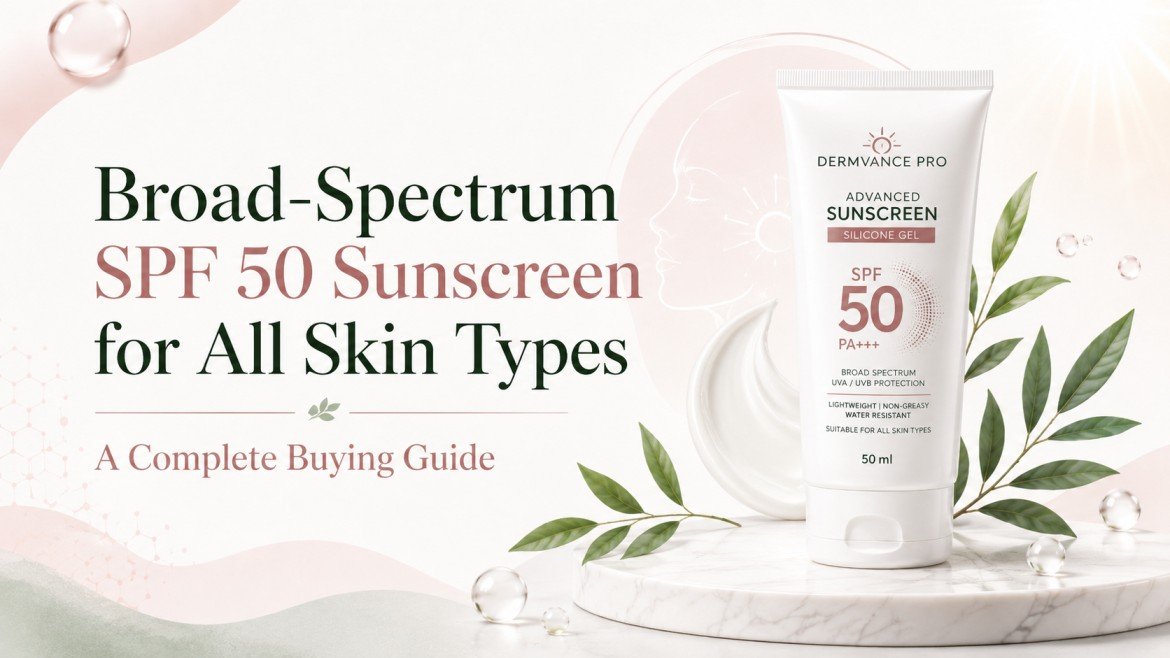
Dermvance Pro’s Advanced Sunscreen Silicone Gel SPF 50 PA+++ is positioned as a broad-spectrum, lightweight, non-greasy, and water-resistant option suitable for different skin types.
Individual tolerance can still vary, so users should always review the label and application instructions.
What Does Water-Resistant Sunscreen Mean?
Water-resistant sunscreen is formulated and tested to maintain its labeled protection for a stated period while the skin is exposed to water or sweat.
It does not mean waterproof.
A water-resistant SPF 50 sunscreen may be useful for:
- Outdoor workouts
- Humid weather
- Swimming
- Sports
- Travel
- Long outdoor activities
Water resistance usually lasts for a specific period stated on the label. Sunscreen should be reapplied after swimming, heavy sweating, towel drying, or when the stated period has passed.
Never assume that water-resistant sunscreen will remain fully effective all day without reapplication.
How to Read a Sunscreen Label
A sunscreen label contains important information that helps you compare products.
Look for the following:
SPF Level
This communicates the tested sunburn-protection level, primarily associated with UVB.
Broad-Spectrum Claim
This indicates that the product has been tested for both UVA and UVB protection.
UVA or PA Rating
Some sunscreens include a PA rating to communicate UVA protection.
Water Resistance
Check whether the sunscreen is water-resistant and how long the claim lasts.
Skin-Type Suitability
The product may be described as suitable for oily, dry, combination, normal, sensitive, or all skin types.
Texture
Look for terms such as gel, lotion, cream, fluid, water-based, silicone-gel, lightweight, matte, or non-greasy.
Application Directions
Follow instructions about when to apply, how much to use, and when to reapply.
Warnings and Storage
Review allergy warnings, age-related guidance, external-use statements, storage directions, and expiration information.
Product claims should be evaluated together. A high SPF does not replace broad-spectrum coverage, proper application, or reapplication.
What Does PA+++ Mean?
The PA rating system is used to communicate the level of UVA protection offered by a sunscreen.
The plus signs indicate increasing levels of UVA protection within that rating framework. PA+++ generally represents a meaningful level of UVA protection.
When reviewing a product with PA+++, also check whether it is labeled broad spectrum and whether its SPF and water-resistance claims match your routine.
PA rating does not remove the need for correct application or reapplication.
How Much Sunscreen Should You Apply?
Applying too little sunscreen is one of the most common usage mistakes.
The sunscreen should form an even layer over all exposed areas, including:
- Face
- Neck
- Ears
- Hairline
- Jawline
- Other exposed skin
Follow the quantity guidance on the label. Many users use the two-finger method as a practical reference for the face and neck, but the amount needed may vary depending on the product consistency, face size, and areas covered.
Do not mix sunscreen directly with moisturizer or foundation in your hand. Mixing can make it difficult to create an even sunscreen layer.
Apply skincare products separately and allow each layer to settle.
When Should You Apply Sunscreen?
Sunscreen should generally be applied as the final step of morning skincare and before makeup.
A simple routine may look like this:
- Cleanser
- Targeted serum, if used
- Moisturizer, if needed
- Sunscreen
- Makeup, if used
Apply sunscreen before outdoor exposure and give it time to settle according to the product directions.
Sunscreen should not be limited to sunny summer days. UV exposure can occur throughout the year, including on cloudy days.
How Often Should You Reapply SPF 50 Sunscreen?
Reapplication depends on your activity and exposure.
Reapply when:
- Spending extended time outdoors
- Swimming
- Sweating heavily
- Towel drying
- The product’s stated water-resistance period ends
- Sunscreen has been rubbed or wiped away
A common outdoor guideline is to reapply approximately every two hours, but users should always follow the product label and adjust based on activity.
Indoor users may have different exposure patterns. Someone seated away from windows may have different needs from someone commuting, working next to a sunny window, or moving between indoor and outdoor environments.
Can You Apply Sunscreen Under Makeup?
Yes. Sunscreen should normally be applied after skincare and before makeup.
To reduce pilling or uneven makeup:
- Avoid applying too many heavy layers.
- Allow moisturizer to settle.
- Spread sunscreen evenly.
- Give sunscreen time to set.
- Apply makeup gently rather than rubbing aggressively.
- Check product compatibility if pilling occurs.
A lightweight broad-spectrum sunscreen for face often layers more easily than a very thick or greasy formula.
Silicone-gel sunscreen may also create a smoother surface that some users find suitable under foundation.
Common Sunscreen-Buying Mistakes
Choosing Only by SPF Number
SPF is important, but broad-spectrum protection, texture, water resistance, and skin compatibility also matter.
Ignoring Your Skin Type
A sunscreen that feels uncomfortable may not be used consistently. Choose a texture that works with your skin and climate.
Assuming Water-Resistant Means Waterproof
Water-resistant sunscreen must still be reapplied after swimming, sweating, or towel drying.
Ignoring UVA Protection
Check for broad-spectrum labeling or a UVA rating rather than relying only on SPF.
Buying a Heavy Formula for Humid Weather
A rich sunscreen may feel uncomfortable during hot or humid conditions. A gel or silicone-gel texture may feel lighter.
Applying Too Little
Using less than the recommended quantity can reduce the expected level of protection.
Skipping Reapplication
Sunscreen can wear away, move, or lose effectiveness during outdoor activity.
Ignoring Product Compatibility
A sunscreen that pills over your moisturizer or under makeup may require changes to layering, quantity, or product combinations.
How to Choose Sunscreen Based on Lifestyle
For Office and Indoor Work
Choose a comfortable sunscreen that:
- Works under makeup
- Feels light during long wear
- Fits into a quick morning routine
- Supports protection during commuting and window exposure
For Outdoor Exercise
Look for:
- Water resistance
- Lightweight application
- Comfortable wear during sweating
- Packaging that allows easy reapplication
For Travel
A travel-friendly sunscreen should offer:
- Broad-spectrum protection
- Suitable SPF
- Portable packaging
- Texture that works across changing weather conditions
- Clear reapplication directions
For Daily Makeup Use
Choose a sunscreen that:
- Spreads smoothly
- Does not feel excessively oily
- Allows makeup to layer evenly
- Does not pill with your other products
- Has a finish you are comfortable wearing
For Men Who Prefer a Simple Routine
A simple morning routine may include cleanser, moisturizer when needed, and sunscreen.
A face sunscreen for men and women should be selected based on skin type, comfort, exposure, and texture preference rather than gender.
Why Choose Dermvance Pro SPF 50 Sunscreen?
Dermvance Pro offers several sun-protection products through its Sunonomics range, including SPF 30 and SPF 50 options in gel, lotion, aqua-gel, and silicone-gel formats.
The Advanced Sunscreen Silicone Gel SPF 50 PA+++ is currently presented with the following features:
- Broad-spectrum UV protection
- SPF 50
- PA+++ rating
- Lightweight texture
- Non-greasy positioning
- Water resistance
- Suitability for all skin types
- 50 ml packaging
These features may make it a practical option for people looking for a smooth, lightweight sunscreen that can fit into a daily routine.
Users should still check the complete product label, ingredients, warnings, and usage directions before purchasing.
Browse the complete Dermvance Pro Skin Care range or explore Sunonomics sunscreen products to compare available formats.
Frequently Asked Questions
Is broad-spectrum SPF 50 sunscreen suitable for daily use?
Yes. Broad-spectrum SPF 50 sunscreen can be used daily when the product is suitable for the user’s skin and applied according to its directions.
What is the difference between broad-spectrum and regular sunscreen?
Broad-spectrum sunscreen has been tested to provide protection against both UVA and UVB radiation. A sunscreen that lists only SPF without a broad-spectrum claim may not clearly communicate UVA protection.
Is SPF 50 suitable for oily skin?
Yes. People with oily skin may prefer a lightweight, gel, aqua-gel, or silicone-gel SPF 50 sunscreen with a non-greasy finish.
Can dry skin use SPF 50 sunscreen?
Yes. Dry skin users may select a more moisturizing formula or apply sunscreen over a suitable moisturizer.
Is SPF 50 too strong for sensitive skin?
SPF 50 is not automatically too strong for sensitive skin. Sensitivity depends on the complete formulation and individual tolerance. Patch-testing may be helpful.
Does SPF 50 last all day?
No. Sunscreen may need to be reapplied, particularly during prolonged outdoor exposure, swimming, sweating, or towel drying.
Can men and women use the same face sunscreen?
Yes. Sunscreen choice should be based on skin type, texture, lifestyle, and individual preference rather than gender.
Is water-resistant sunscreen waterproof?
No. Water-resistant sunscreen only maintains protection for a specified period during water or sweat exposure and still requires reapplication.
Can SPF 50 sunscreen be used under makeup?
Yes. Apply sunscreen after skincare and before makeup. Lightweight and silicone-gel textures may be easier to layer.
Where can I buy Dermvance Pro SPF 50 sunscreen?
You can purchase and compare sunscreen options through the official Dermvance Pro website, the Skin Care category, and the Sunonomics collection.
Conclusion
Choosing sunscreen involves more than selecting the highest SPF number.
A suitable broad-spectrum SPF 50 sunscreen for all skin types should support protection against UVA and UVB exposure, feel comfortable on the skin, match the user’s lifestyle, and be practical enough for consistent application.
Oily skin may prefer lightweight gel or silicone-gel textures. Dry skin may need greater moisturizing support. Combination skin often benefits from a balanced formula, while sensitive skin users should review ingredients and patch-test carefully.
Broad-spectrum labeling, UVA rating, water resistance, texture, application directions, and reapplication guidance should all be considered before buying.
Explore Dermvance Pro sun-protection products and choose an SPF 50 sunscreen that fits naturally into your daily skincare routine.

